- Wild
- The octopus
- framed, labelled
- Scatter
- The tug
- labelled on reel
- Multiplier
- Pearl in a shell
- studio and listing
- Creatures
- Five
- captured screens
- Card ranks
- 10 J Q K A
- captured screens
OctoWins Pateplay · underwater slot
The OctoWins reels carry three kinds of thing: two special symbols that do a job, a handful of sea creatures that pay, and a set of card ranks cut out of painted wood. Telling them apart quickly is most of what makes a cascade readable, because a chain moves fast and the screen rearranges itself while it does.
What follows describes each group as it appears on the captures of the game this site holds, and says plainly where a value is something the game prints inside itself rather than something a page can publish.
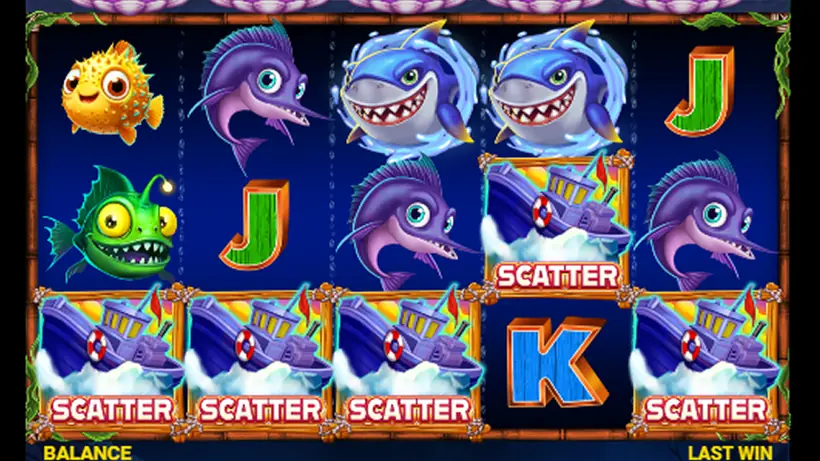
The art has one clear priority, which is that every creature on the reels should be identifiable from its outline alone. A shark is a blue wedge with a grin. A swordfish is a purple spike with a dorsal fin standing up like a crest. An anglerfish is green, round and lit by its own lamp. A pufferfish is yellow, almost spherical and covered in blunt spines. A hermit crab is a red mass in a coiled shell with both claws forward. None of them can be mistaken for another at a glance, and that is the point: the cascade keeps rewriting the screen, and a player who has to study each cell to work out what is in it loses the thread.
The background does the opposite job. It is deep blue inside the reel frame and a brighter, lit ocean outside it, so the frame itself reads as a window rather than as a panel bolted onto a picture. Coral grows up both sides of the frame, and an octopus — not the wild, the host — is behind the ladder of pearls with its arms wrapped around the chain. That host octopus is part of the furniture, not part of the reels, and confusing the two is easy on a first look.
The card ranks are 10, J, Q, K and A, cut out of painted wood. Each one is a slab of painted wood with the letter cut out of it: the ten in pink on orange, the jack in green, the queen in red, the king in blue, the ace in yellow. Colouring each rank differently rather than giving them all one treatment is a small thing that matters a great deal on a five-by-three grid where most of the screen, most of the time, is letters.
The wild is an orange octopus, and it is the only symbol that arrives wearing a frame — a square gilt border with the word set across the bottom edge of it. On the narrow layout it is the one piece of the grid with a border at all, which makes it findable in a glance even when the screen is a third its desktop size.
Two rules attach to it, both from Pateplay's own record of the game. It substitutes for every paying symbol except the boat. And it only appears after a cascade has paid, which means it is structurally incapable of landing on the screen a spin opens with. The effect is that the wild is always an extension of something already happening rather than the start of it — there is no such thing in this game as a spin that opens with a wild on reel three.
That rule is also why the wild is best thought of as part of the cascade rather than as a symbol in its own right. On a game where wilds can land at any time, a player watches for them. Here there is nothing to watch for until a win has already been paid, at which point the wild becomes one of the things that might keep the chain alive for another screen.
The scatter is a small purple tug with life rings along its side, throwing a white bow wave, with the word printed on a plate beneath it. It is the symbol that opens the bonus round, and it is the one symbol the octopus will not replace — which is the standard arrangement and the reason a bonus round cannot be manufactured by a well-placed wild.
How many boats are needed is one of the few things about this game that the sources do not agree on. Pateplay's own written description of the feature gives one threshold; the listing that reproduces the game's specification gives a lower one. The capture above shows five of them on screen at the same moment, which is consistent with either account and settles neither. The bonus round page sets that disagreement out properly, along with a second one about how many spins the round is worth, because taken together they are the clearest illustration on this site of why a single confident number is often the least honest thing a page can print.
What the boats do not do is pay on their own as a line. They are counted wherever they land rather than read from the left like the creatures, which is the ordinary meaning of a scatter and the reason they can be spread across the grid the way the capture shows.
Pearls appear twice in this game and it is worth separating them, because a reader looking at a capture will see both at once and reasonably assume they are the same mechanism.
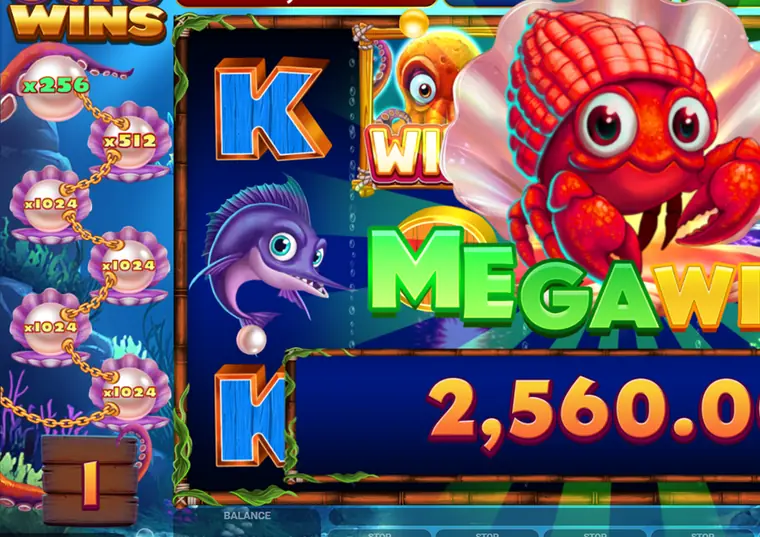
The first lot are the ladder: a chain running up the side of the reel frame on the wide layout and across the top on a phone, with a shell every so often and a pearl lying open in it carrying a value. Those values are fixed; the ladder is a position the round climbs to, not a thing that lands.
The second lot land on the reels themselves. Pateplay describes multiplier symbols turning up at random across all the reels during ordinary play and during the bonus round, each taking a value drawn at random within a published range when it arrives. The listing that covers the game calls these pearl multipliers by name and treats them as one of the two headline mechanics; the review that covers it singles them out for being drawn as objects native to the sea floor rather than as numbers printed on tiles. They are the reason a chain can produce a large result even when the ladder has not climbed far.
There are no symbol values anywhere on this site, and the omission is deliberate. A paytable in a game of this kind is relative to the stake and is displayed inside the game, where it is correct for the copy being played and for the currency it is being played in. Copying a column of figures out of one capture would produce a table that is right for one stake in one currency on one day and quietly wrong everywhere else, and a reader has no way of telling which.
The same applies to the amounts legible on the four counters above the reels and to the balances and win figures at the bottom of each capture. They are whatever happened to be on the screen when it was taken. They are not a property of the game, they are not a promise, and they are not reproduced in the text of this site for the same reason a photograph of somebody else's winning ticket is not evidence about a lottery.
What this page does publish is what can be seen and checked: which symbol does which job, what the special ones refuse to do, and where the published descriptions of the game disagree with each other. That is a smaller claim than a paytable, and it has the advantage of still being true next month.
Each answer below is the one carried in this page's structured data, word for word.
The octopus, shown inside a gilt frame with the word printed across the bottom. It stands in for everything except the boat.
The boat — a purple tug throwing a bow wave, with the word printed under it. It is the one symbol the octopus will not replace.
Multiplier symbols. They land during ordinary play and during the bonus round alike, and each carries a value drawn at random when it arrives.
The site does not publish symbol values. Pateplay prints them in the paytable inside the game, where they move with the stake, and copying them here would mean copying a figure that changes.
Nothing on the captured screens shows a stack. Repeats of a creature turn up on separate reels rather than filling a column.
Any symbol that took part in the combination being paid. Everything else stays where it is and drops to fill the gap below it.