- Return
- 96.00%
- studio and listing
- Ceiling
- 5,000x
- studio and listing
- Reels by rows
- 5×3
- studio and screens
- Ways
- 243
- studio's own record
- Volatility
- High
- studio and listing
- Released
- April 2026
- month only
OctoWins Pateplay · underwater slot
This page gathers the numbers for OctoWins and says where each one comes from. There are four kinds of source behind them: Pateplay's own record of the game, the captures of the game itself, a single outside listing that reproduces the full specification, and the pages that stood on this domain before.
Where those agree, the figure is simply stated. Where they do not, both are shown. Nothing here is averaged, and nothing is borrowed from a page about a different game.
The published return is 96.00%. Pateplay keeps a record of each of its games with a return field in it, and for this title that field holds one value. The outside listing that reproduces the whole specification prints the same value. The pages that stood on this domain before printed it too. Three independent sightings of one number, and no sighting anywhere of a second.
That last point is the one worth dwelling on, because it is a place where a site like this one can go wrong while trying to be careful. A great many slots are supplied in more than one return build, the operator installs whichever it likes, and the responsible way to write about such a game is to print the set and say the panel inside the game settles it. That sentence has become a reflex, and the trouble with a reflex is that it gets applied to games it is not true of. For this title there is no set: the studio prints one figure, nobody prints another, and saying "the operator chooses" would be a claim with nothing behind it dressed up as caution.
So the honest form is narrower. One figure is published and it is the only one in circulation. The panel inside a copy of the game is still where a player should confirm it, because that is true of every slot anywhere and costs nothing to say. What is not said here is that this particular game is known to vary, because it is not known to.
Volatility is high. That is not somebody's impression of how the game felt: the studio's record carries a volatility field and this title is filed at the top of its scale, and the listing that covers the game gives the same rating. It fits what the design implies — a ladder whose values double, a ceiling five thousand times the stake and a bonus round that has to be waited for are the ingredients of a game that pays rarely and awkwardly rather than steadily.
5,000x the stake. The studio publishes it as the game's maximum multiplier, the listing repeats it, and the pages that stood here before carried the same figure. Nothing disputes it.
What needs care is what it is measured against and how it is reached. It is a multiple of the whole stake for the round, which on this game is a single figure because there is no line count to divide it by. And it is a ceiling on a round, not on a spin: a round in this game can be a chain of cascades with the ladder climbing through it, and the ceiling is the limit on all of that together.
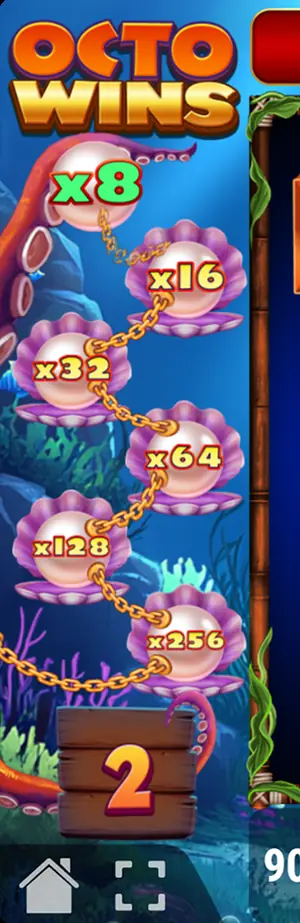
The studio also describes the ladder beside the reels as climbing toward that same figure, which blurs two things that are worth keeping apart. The ladder is a multiplier position; the ceiling is the most the game will pay. The largest value legible on any pearl across the captures this site holds is well below the ceiling, so the ceiling is not simply the top of the ladder written out — it is what a long chain multiplied at a high position on the ladder could in principle come to.
The grid is 5 reels with 3 symbol positions visible on each, and the game pays 243 ways. Those two statements are the same statement. A ways game reads a combination by taking a symbol on the leftmost reel and following it onto the next reel and the next, with the position within each column making no difference; the number of ways is the number of distinct position-combinations such a run can occupy, which on five reels of three is three multiplied by itself five times. That is 243 exactly.
The arithmetic is not a curiosity — it is a check, and it is worth having because this kind of figure is easy to get wrong when it is copied between pages. A game sold on 243 ways cannot be on four reels, cannot be on six, and cannot have four rows: those give 81, 729 and 1,024. Five by three is the only shape that produces the number, and it is also what the studio's record says and what every capture of the game shows. Three independent confirmations, one of which is a sum anybody can do.
The same check is a reason to be careful with wording found elsewhere. The listing that reproduces this game's specification labels the figure "paylines" in one row of its own table and "ways" in the next. They are not the same thing: a payline is a fixed path drawn across the reels, and this game has none — the studio files it under ways and leaves its payline field empty. A reader who takes "243 paylines" literally will look for 243 drawn lines on the screen and find nothing, because there is nothing to find.
The game was released in April 2026. The month is as precise as this page will be, and the reason is that the three sources which give a day give three different days inside it: the studio's own record, the listing that reproduces the specification, and a review of the game each name a different one. They are within about a fortnight of each other, which is the usual spread between a build date, a first availability date and the day somebody wrote about it.
Picking one of the three would mean deciding which kind of date the reader asked for, which nobody can know. Printing all three would turn a small fact into a paragraph. The month is what all three agree on, so the month is what is printed. This site shows no dates of its own anywhere, for a separate reason: a visible review date on a page like this tells a reader when somebody last looked, which is not the same as when the facts last changed, and the two get confused.
A hit frequency of 21.1% appears on exactly one outside listing. The studio does not publish a hit frequency for this game, no other source repeats it, and the pages that stood here before never carried one.
It is printed here because leaving it out would be its own kind of editing — a reader who meets it elsewhere deserves to know that it exists and that it rests on a single source. It is not printed as settled. A hit frequency is also one of the easiest figures to misread: on a game that cascades, "how often does a spin pay" and "how often does a screen pay" are different questions with different answers, and a bare percentage does not say which one it is answering.
The same caution applies in the other direction to figures this site does not publish at all: symbol values, how often a chain runs past one refill, how often the bonus round opens, and any rating or score for the game. Numbers for some of those circulate. None of them comes from here.
Four counters run along the top of the screen in every capture, and both the studio's filing of the game and the outside listing describe it as connected to a four-level jackpot with a mystery cash feature beside it. That is a real part of the product and it was missing from this site entirely until now.
It does not, however, add a number to this page. The amounts on a progressive meter belong to the operator running the pool: they rise with everybody staking into it, they reset when somebody takes the top one, and they differ between venues. The figures legible on the captures are a snapshot of one pool on one day. Reprinting them as specifications of the game would be the single most misleading thing this site could do, which is exactly why they are described and not quoted.
There is one further consequence worth stating plainly. A published return is a property of the game's own maths. Where a jackpot pool sits on top of a game, how its contribution is accounted for is an arrangement between the studio and the operator, and nothing available from outside explains how it is handled for this title. That is a gap in what is knowable, not a gap in this page, and filling it with a plausible sentence would be the kind of invention the rest of this site is written to avoid.
The return, the ceiling, the grid, the ways count, the volatility rating and the release month all come from Pateplay's own record of the game, reached at the address this domain had already named as its source before any of this was rewritten. The listing that reproduces the full specification independently confirms the first five of those.
The ladder values, the cascade counter, the layout of the controls, the price shown on the toggle, the two tiles on the purchase panel and the award count on the bonus panel come from captures of the game itself that were already in this domain's own asset folder. They are the strongest kind of source there is for how a game looks, and on one point — the number of free spins — they disagree with the studio's own written summary, which is set out on the bonus round page rather than smoothed over.
The hit frequency comes from one listing and is labelled as such everywhere it appears here. The existence of the demo comes from the studio's record and from two listings that offer one. And the jackpot comes from three directions at once — the studio's own filing of the game, the listing, and the four counters sitting in plain sight on every capture.
Each answer below is the one carried in this page's structured data, word for word.
96.00%. The studio's own record carries that one figure with nothing beside it, and the outside listing of the specification carries the same one.
Nothing we can check says so. No source shows a second percentage for this title, and this page does not borrow the sentence about operators choosing a build from games where it is documented.
5,000x the stake. The studio publishes it, the listing repeats it, and the pages that stood here before carried the same figure.
Three positions on each of five reels, and a run read from the left along neighbouring reels wherever the symbols sit. Three to the fifth power is 243, which is every combination of positions such a run can take.
High. It is a field in the studio's own record rather than somebody's impression, and the listing agrees with it.
April 2026. Only the month is given here: the studio, the listing and a review each name a different day inside it.
A single outside listing publishes a hit frequency of 21.1%. Nobody else repeats it and the studio does not publish one, so it belongs to that listing and is not treated here as settled.