- Published return
- 96.00%
- studio's own record
- Ceiling, on the stake
- 5,000x
- studio and listing
- Grid
- 5×3
- studio and screens
- Ways to win
- 243
- studio's own record
- Volatility
- High
- studio and listing
- Jackpot meters
- 4
- screens and listing
OctoWins Pateplay · underwater slot
OctoWins is an underwater slot built by Pateplay on 5 reels of 3. It pays 243 ways instead of along lines, every paid win clears itself off the screen and lets the gaps refill, and a ladder of pearls beside the reels climbs a step at a time while that is happening.
This page is the whole game in one pass: who built it, how a round is read, what sits around the grid, and which of the published figures hold up when they are checked against each other.

The game is an ocean-floor slot with an octopus for a host. Five reels, three symbols visible on each, 243 ways, a cascade after every paid win, a multiplier ladder up the side of the screen and a row of jackpot meters along the top. The studio rates it high, publishes a return of 96.00% and a ceiling of 5,000x the stake, and released it in April 2026.
The spelling belongs in that list because it was wrong here for a long time. These pages used to write the title with a single capital, and a reader who went looking for the game in that form found a microphone preamplifier, a racehorse called Woodstock Octo and a consultancy whose press releases begin with the same two syllables. The studio writes it OctoWins: one word, with the second half capitalised, which is also how the banner above sets it in type and how every listing that covers the game writes it. Nobody splits it into two words. The partner link is unaffected either way, because the parameter it carries is lowercased before it is sent — so this is a correction made for people, not for machinery.
The other half of that correction is that the bare name is not enough on its own. Pairing it with the word "slot" makes things worse rather than better, because there is a second octopus-themed slot from a different studio with a similar name and a much larger following, and the two get confused constantly. Its numbers are not these numbers: a different return, a different ceiling, a different grid and a cluster mechanic instead of ways. Anywhere the name appears on this site it is attached to Pateplay, which is the one addition that reliably separates the two.
A spin lands fifteen symbols: five columns, three rows. There is nothing to configure beyond the stake, because the game has no payline count — a combination is read by taking a symbol on the leftmost reel and following it onto the reel beside it, and the next, for as long as the run holds. Where in the column each copy sits makes no difference. That is what 243 ways means, and it is the whole reason the screen can stay as uncluttered as it does: no overlay of coloured lines, no paytable diagram, just the creatures.
Every paid combination then removes itself. The symbols that formed it vanish, whatever was above them drops into the hole and new symbols fill the top, and the refilled screen is read again from the left. That continues until a screen pays nothing. One stake can therefore produce several separate results, and understanding that is the difference between following the game and being baffled by it: a long chain is one bet with several outcomes, never several bets.
The stake is a single figure, which is worth saying because it is unusual enough to catch people out. Games with lines ask for two numbers — a bet per line and a number of lines — and the multiples quoted for them have to be read carefully as a result. Here there are no lines to buy, so the figure on the button is the whole cost of the round, and every multiple on these pages is a multiple of that one figure. The captured screens show a strip of quick stakes along the bottom edge, rising in uneven steps rather than doublings, with the selected one highlighted; what those steps are in any particular copy of the game depends on the currency and on the operator, and no figure from a capture is reproduced here as a limit.
The cascade is also what makes the rest of the screen work. The wild only arrives after a cascade has already paid, so it cannot land on an opening screen. The ladder of pearls up the side moves while the chain is running. A counter in a small wooden box at the edge of the grid keeps the number of refills in the current chain, which is the single most useful thing on the screen for a reader trying to work out what just happened.
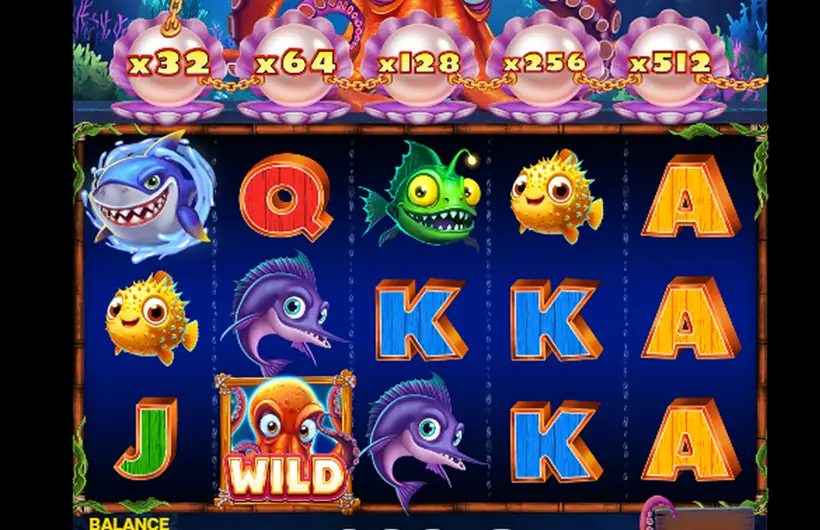
The ladder is a chain of pearls, each sitting open in its own shell, running up the side of the reels on the wide layout and across the top on a phone. The steps are doublings. Across the captures of the game that this site holds, the legible values are x1, x2, x4, x8, x16, x32, x64, x128, x256, x512 and x1024 — and the highest of them is repeated more than once near the top rather than carrying on doubling, so the climb flattens out at the end instead of running away.
Pateplay describes the ladder as climbing from a doubling at the bottom all the way to the game's ceiling. That sentence is doing two jobs at once and it is worth separating them. The ceiling, 5,000x the stake, is the most a round can return at all; the ladder is the mechanism that makes a round large enough to get near it. The steps printed on the pearls are not the ceiling written out — the largest one visible is a good deal smaller than it.
Alongside the ladder there are pearl symbols that land on the reels themselves and carry a value of their own, drawn at random each time. The studio's own description of them gives a range that tops out well below the game's ceiling, which is consistent with the way the ladder behaves: the big figures in this game are things that accumulate over a chain of cascades, not single symbols that land and pay.
Every capture of this game carries a row of four coloured counters across the very top of the screen, above the reel frame, each ticking in its own currency. They are a jackpot: the studio files OctoWins under one of its jackpot series, and the listing that reproduces the game's full specification says in as many words that it is wired into a four-level jackpot, with a separate mystery cash feature beside it.
This site's earlier pages did not mention any of that, which was a real omission rather than a stylistic one: four meters are the largest thing on the screen and a reader looking at a capture would have had no idea what they were. What is worth being careful about is the other direction. The amounts on those meters are not a property of the game. They belong to the operator running the pool, they move with everybody staking into it, and nothing on this site can tell a reader what they will be anywhere in particular.
The return is 96.00%. The studio's record of the game carries that one number and nothing beside it; the listing that reproduces the specification carries the same number; the pages that stood here before carried it too. The ceiling is 5,000x the stake and is agreed by everybody. The volatility is high, which the studio states outright and the listing repeats.
There is a sentence that gets attached to return figures on sites like this one almost by reflex — that the game ships in several builds and the operator picks which one to install, so the panel inside the game is the only authority. For a good many slots that is true and documented. For this one there is nothing behind it: the studio publishes one percentage, no source shows a second, and writing the sentence anyway would be inventing a qualification to sound careful. So it is not written. What can honestly be said is narrower: one figure is published, it is the only one anybody prints, and the information panel inside a particular copy is still the place to confirm it — because that is true of every slot, not because this one is known to vary.
The volatility rating is worth a line of its own, because it is the figure that tells a reader most about what an hour with this game is like and it is the one people skip. A high rating means the return arrives in a small number of large payments rather than steadily, so a run of nothing is normal rather than a sign that something is wrong, and the published return describes an enormous number of rounds rather than an evening. The design says the same thing: a ladder that has to be climbed, a bonus round that has to be waited for and a ceiling five thousand times the stake are the ingredients of a game that is quiet for long stretches.
One figure on these pages belongs to neither the studio nor this site: a hit frequency of 21.1%, which a single outside listing publishes and nobody else repeats. It is on the figures page, marked as that listing's, and it is not repeated as though it were settled.
A demo of this game exists. The studio's own record of it carries a demo identifier, and two of the listings that cover the title offer a free round outright — one of them says the round loads without a sign-up of any kind. None of the sources checked for this game says the opposite, which is worth stating because it is not always so: across the slots this network writes about, pages titled "free play" quite often say in the body that the demo is not available on that site after all.
Whether a free round is actually offered depends on the venue rather than on the game, and it is not offered here. There is no game on this site, no window pretending to be one and no link dressed up as a demo. What a free round is genuinely good for with this particular title is watching one chain of cascades run to a stop while keeping an eye on the ladder, because the relationship between those two things is the whole design and it is much easier to see than to read about. What it cannot show is the only thing that changes when money is involved, which is what a losing run feels like. The mathematics is identical; the person is not.
Every answer below is the one carried in this page's structured data, word for word.
Pateplay. The studio keeps its own record of the game, and that record is where the grid, the return, the ceiling and the feature list on this site come from.
OctoWins — one word, with a capital on both halves. That is how the studio writes it in its own catalogue and how the game's banner art sets it. It is never two words.
96.00%. The studio gives one figure, an outside listing of the full specification gives the same one, and nothing anywhere shows this title running at a second percentage.
5,000x the stake. Every source checked gives the same ceiling, and it is the figure under the button at the top of this page.
No. The game pays 243 ways: matching symbols on neighbouring reels from the left pay wherever they sit on those reels, so there is no line to cover and no line count to choose.
It is the multiplier the game is built around. The steps run in doublings beside the reels, and the cascade is what moves a round up them.
Yes — four meters run along the top of the screen in every capture of the game, and the studio files the title under one of its jackpot series. The amounts on those meters belong to the operator running them, not to the game.
A demo of the title exists: the studio carries a demo identifier for it and two listings offer a free round. There is none on this site — no game runs here, no account exists here and no stake is taken here.