- Grid in portrait
- 5×3
- captured screens
- Ladder position
- Above the reels
- captured screens
- Ladder steps shown
- Five
- captured screens
- Install needed
- None
- browser game
OctoWins Pateplay · underwater slot
OctoWins is one game with two layouts rather than a desktop version and a cut-down one. The reels, the ways, the cascade and every published figure are identical on a phone. What the narrow screen changes is the arrangement of everything around the reels — and one piece of it moves far enough to change how the game is read.
This page describes the portrait layout as the captures of it show it, and says which parts of a round are genuinely harder to follow at that size.
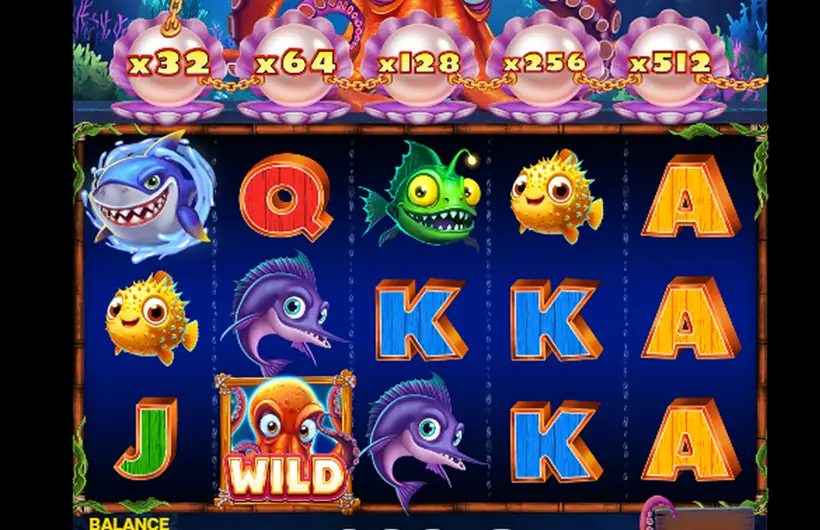
It is worth saying first because it is the thing most often got wrong about phone versions of slots. 5 reels, 3 rows, 243 ways. The portrait captures show the same fifteen cells as the wide ones, with the same creatures in them and the same wooden letters between them. The published return, the ceiling and the volatility rating belong to the game rather than to a layout, and there is no second set of figures for a phone.
The reels are drawn slightly taller than wide in portrait, which is what gives the cells room on a narrow screen without shrinking the artwork. The shark, the swordfish, the anglerfish and the pufferfish keep their full detail; the framed octopus keeps its frame and its label; the boat keeps the plate with its name on it. That matters more than it sounds, because this is a game where the screen rewrites itself several times per stake and a reader who cannot identify a symbol at a glance cannot follow a cascade at all.
The ladder moves. On a wide screen it is a vertical chain up the left of the reel frame, with the host octopus behind it and a shell every so often. In portrait it becomes a horizontal row of five shells sitting directly on top of the grid, with the octopus spread out behind them.
Two things follow from that. The first is that only part of the chain is visible at once: five steps rather than the full run, so a player sees a window onto the ladder rather than the whole of it. The captures show that window at different heights — one at the bottom of the chain, one part way up — which means it scrolls with the round rather than staying put. The second is that the ladder and the reels are now adjacent rather than side by side, so the eye travelling from a win to the multiplier it fed moves a short distance upward instead of a long distance sideways. On balance that is an improvement: the two things the round is about end up next to each other.
The wide layout puts its spin control as a large round button on the right-hand side, with the stake and the sound and menu controls stacked around it, and the quick-stake buttons in a strip along the bottom. In portrait the strip along the bottom is where the controls go, which is the reach a thumb actually has on a phone held in one hand.
The balance sits at the bottom left and the win at the bottom right on both layouts, which is the one piece of the interface that does not move at all. The cascade counter keeps its small wooden box at the edge of the grid in portrait as it does on the wide screen, and on a phone it is arguably more useful rather than less: with less of the ladder visible, the counter is the quickest way to tell how far into a chain a round has got.
The panels that come up over the reels — the bonus award, the purchase panel — are drawn across the width of the screen in both layouts, so they are the parts of the game that change least between them. The purchase panel's stake selector, with its minus and plus either side of the figure, is sized for a touch rather than a pointer in both.
One thing, and it is the thing the game is built on: following a long chain. Each refill rewrites part of the screen, and on a phone the whole screen is roughly the size of one desktop reel. Symbols leave and arrive faster than the eye can account for them, and the honest advice is to stop trying to watch the reels and watch the counter instead — it says how many refills have happened, and the ladder above says what that has been worth.
The second thing is not harder so much as different: with only five steps of the ladder in view, there is no sense of how much further it could go. On a wide screen the whole chain is visible at once and the shape of the climb is obvious, including the flat stretch at the top where the same value repeats instead of doubling. In portrait that flattening is invisible until a round gets there.
The third is a reading problem rather than a layout one, and it applies to any slot played in a pocket: the quick-stake strip puts several figures within a thumb's reach of each other, and on a narrow screen the gap between the smallest and the largest is a few millimetres. On the wide layout the same strip is spread across the foot of a monitor. Nothing is hidden and nothing is mislabelled either way, but a stake that takes a deliberate movement to change is different from one that takes a twitch, and that is worth knowing before a session rather than after it.
Nothing else about the game suffers. The symbol art survives the size reduction, the special symbols keep their frames and plates, the stake is a single figure with no line count to fiddle with, and the two priced controls are buttons with their state visible rather than settings buried in a menu.
This is a browser game. It loads in whatever browser a phone already has, there is nothing to install and Pateplay does not publish an installable version of this title. Anything offering itself under the game's name as a download did not come from the studio, and a reader who meets one should treat the name on it as decoration.
Where the game is actually played is an operator's site, and that is a separate question from the layout. The button at the top of every page here goes to one, in a new tab, after asking an age question. A free round, where it is offered, is also something the venue provides rather than the game: the studio's own record carries a demo identifier and two listings offer one, but none of that is on this site. Nothing runs here and nothing is staked here.
Each answer below is the one carried in this page's structured data, word for word.
No. The same grid, the same ways, the same cascade and the same published figures. What changes is where the furniture around the reels is put.
The ladder. It leaves the side of the reels and runs across the top instead, showing a handful of steps at a time rather than the whole chain.
They are not in the frame on the portrait captures this site holds. The top of a phone screen is where the ladder went, and there is no room left above it.
Not from Pateplay. The game runs in a browser. Anything offering itself as an installable version of this title under that name did not come from the studio.
No. It is 5 reels of 3 on a phone exactly as on a desktop, and the symbols are drawn large enough to stay apart at that size.
A long chain. Symbols leave and arrive quickly, and the counter in the wooden box at the edge of the grid is the thing to watch rather than the reels.